Online Nursing School: The Real Pros and Cons
Online nursing school is real and growing — but "fully online" RN programs are mostly a myth. Pre-licensure ADN and BSN programs still require in-person clinicals and labs. Here are the honest pros, the cons people gloss over, and how to vet a program before you enroll.

Online nursing school is a legitimate path — but a "fully online" RN program for someone who is not already a nurse does not exist. That is the single fact that cuts through most of the marketing. Pre-licensure programs (the ADN or BSN you take when you are not yet licensed) deliver lecture content online, but clinical rotations, simulation labs, and skills check-offs are always in person. What people mean by "online nursing school" is usually a hybrid: theory on a screen, hands-on training in a building. The genuinely online tracks — RN-to-BSN and most MSN programs — are for people who already hold a license. Get that distinction right and the pros and cons line up cleanly. Below is the honest version: what online format actually buys you, what it costs you, and how to vet a program before you sign anything.
What "online nursing school" actually means
This is where most articles go vague. "Online nursing school" is not one thing — it is a category covering very different program types, and the in-person requirement depends entirely on which one you are in.
Program type | Who it is for | How "online" it really is |
|---|---|---|
RN-to-BSN | Already-licensed RNs | Can be fully or almost fully online; theory-heavy, minimal in-person |
Pre-licensure ADN / BSN | People not yet nurses | Hybrid only — coursework online, clinicals and labs always in person |
RN-to-MSN / DNP | Licensed RNs advancing | Hybrid — online coursework plus required in-person clinical hours |
So when someone says "I am doing online nursing school," what they usually mean is that the academic coursework is online and the hands-on components are not. That distinction matters a lot — it decides whether the format is even an option for you. If you are still mapping out the steps, start with the nursing school requirements and the ADN vs BSN decision before you worry about format.
The real pros of online nursing school
These are legitimate advantages, not marketing spin — provided you are in a program format where online actually applies.
Flexibility that fits a working life. Asynchronous classes let you study at 11pm after the kids are asleep or at 6am before a shift. If you are a CNA or patient-care tech earning while you learn, that flexibility is not a perk — it is the only way the math works.
You can keep your income. Quitting a job to attend class full-time is not realistic for most people. Online and hybrid formats let you keep working while you build toward the degree.
Lower overhead and wider access. No commute, no campus parking, no relocating. For students in rural areas or states with few programs, online coursework opens up accredited schools that would otherwise require a move.
You can replay the hard lectures. Being able to rewatch a pharmacology or pathophysiology module until cardiac output finally clicks is genuinely useful — and impossible in a one-shot live lecture.
Often fewer waitlist bottlenecks. Online classrooms do not have the physical-seat limits that create multi-year waitlists at some traditional schools, so you may be able to start sooner. (Pre-licensure clinical placements can still bottleneck — ask about that specifically.)
The cons people gloss over
The in-person requirements are non-negotiable
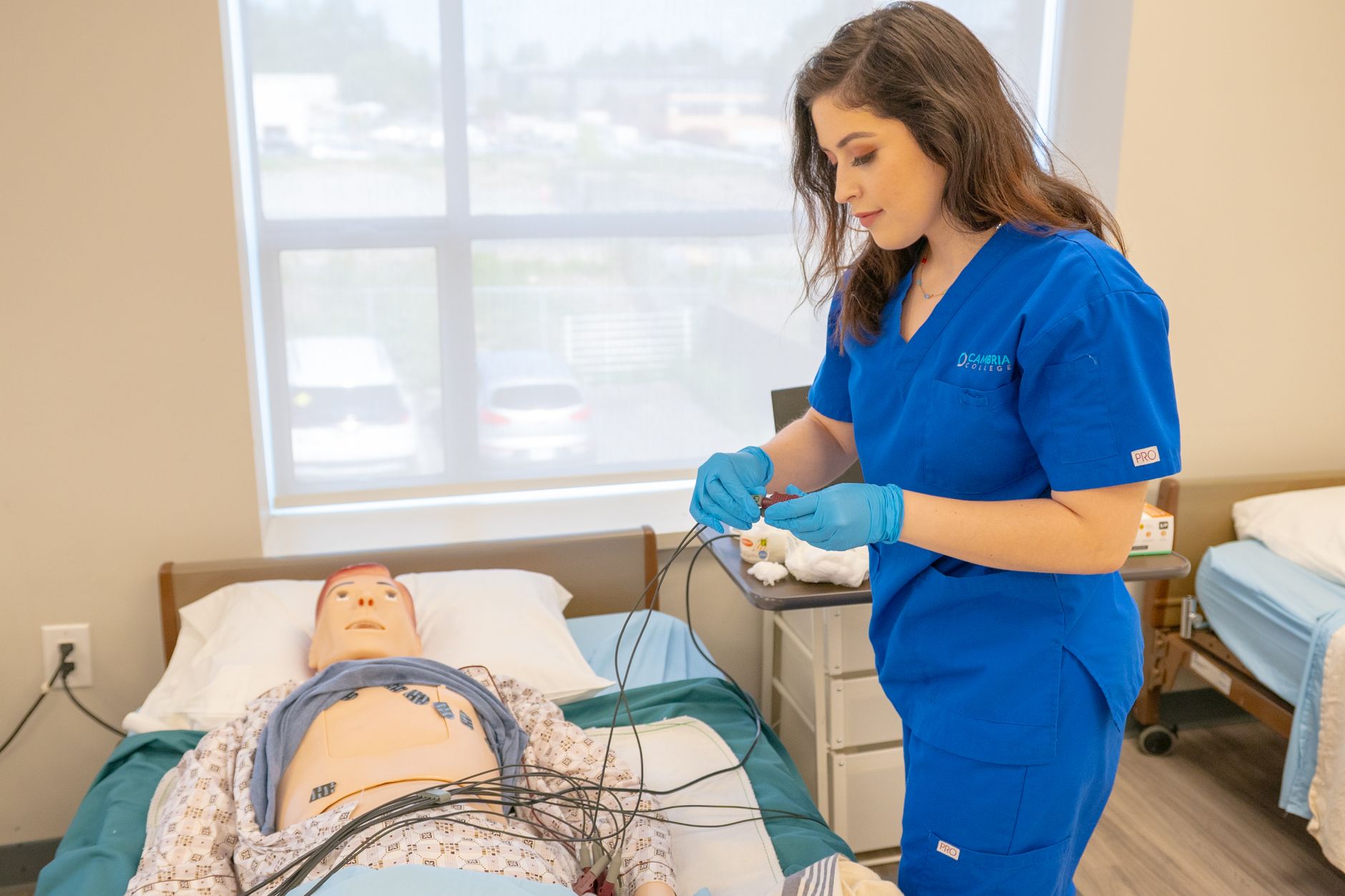
Be direct about this: if a pre-licensure program tells you nursing can be learned 100% online, walk away. Clinical hours, simulation labs, and skills check-offs require physical presence. There is no digital substitute for practicing IV insertion, running a simulated patient through a mock code, or completing a real rotation in a hospital. Even fully hybrid programs require hands-on work in skills and simulation labs and clinical rotations at healthcare facilities — components that cannot be done remotely. This is also why online format does not shorten the timeline; see how long nursing school takes for what the clinical hours add up to.
Self-discipline is a prerequisite, not a bonus
Online learning works well for students who are self-motivated, organized, and consistent. It fails students who need external structure to stay on track. Nursing content is dense — anatomy, physiology, pharmacology, pathophysiology — and none of it absorbs passively. Studying in the same space where you relax can actively work against focus. If you know you need a classroom to stay accountable, that is not a weakness; it just means in-person is the better fit.
Isolation is a real problem
Online nursing students often report feeling disconnected from classmates, instructors, and the culture of nursing itself. Nursing is a team profession, and the study groups and shared pre-exam panic build professional bonds that carry into your career. You can compensate with deliberate effort — local study groups, treating in-person lab days as social opportunities, joining student forums — but it takes intentional work that an on-campus program gives you by default.
Accreditation gaps can hurt your career
Not all programs are accredited equally. The two nursing-program accreditors are CCNE (the Commission on Collegiate Nursing Education, which accredits baccalaureate and graduate programs — so RN-to-BSN, MSN, and DNP) and ACEN (the Accreditation Commission for Education in Nursing, which accredits all levels, including associate-degree/ADN programs). If you are pursuing an ADN, you are looking for ACEN accreditation, since CCNE does not accredit associate-level programs. A degree from a non-accredited program can disqualify you from certain jobs and graduate programs and complicate licensure. Do not assume — check the accreditor lists yourself before you enroll.
Tech problems become your problem
A reliable high-speed connection stops being optional. If your internet drops the night an assignment is due, or your laptop dies before a proctored exam, you need a backup plan and you need to know exactly who to call. Online programs have less patience for tech excuses than a professor standing in front of you.
Online vs. in-person: the honest comparison
Factor | Online / hybrid | Traditional in-person |
|---|---|---|
Schedule | Flexible, often asynchronous | Fixed class times |
Works while studying | Easier to keep a job | Harder; schedule competes with work |
Accountability / structure | Self-directed; you supply the structure | Built-in structure and real-time feedback |
Peer / instructor connection | Requires deliberate effort | Organic, day-to-day |
Clinical training | In person — required | In person — required |
The clinical-training row is identical on purpose. That is the equalizer: no matter where you study theory, you learn nursing with your hands in a real clinical environment. Online format changes how you take lectures — it does not change what it takes to become a competent nurse.

Who should seriously consider online
Online or hybrid format tends to work well if you:
Are an existing RN pursuing a BSN or MSN.
Have a stable job you cannot leave while studying.
Are a highly self-directed learner with strong time management.
Live far from programs with rigid in-person schedules, or have family responsibilities that make fixed class times impossible.
It is probably not your best fit if you are just starting out with no clinical experience, you struggle to stay on task without external accountability, you learn best by asking questions in real time, or you are hoping to avoid the in-person components entirely. There is no shame in either answer — nursing school is hard regardless of format, and the real question is which structure gives you the best shot at finishing.
How to vet a program before you enroll
Verify accreditation yourself. Confirm the program is CCNE- or ACEN-accredited directly on the accreditor list — not on the school's own marketing page. For an ADN, expect ACEN.
Pin down the in-person logistics. Ask where the skills and simulation labs are located, how many clinical hours are required, and — critically — who arranges your clinical placements: you or the school.
Check NCLEX pass rates and licensure eligibility. Confirm the program qualifies you to sit for licensure in your state, and look at its first-time NCLEX pass rate. The exam does not care how you studied.
Match the format to your honest self-assessment. If you need structure to stay on task, choose the program that supplies it rather than the one that promises the most flexibility.
Written by · Verified educator
Testavia editorial
Nathan Cole
RN
Medical-Surgical nurse & health writer
Meet Nathan, a registered nurse with over five years of experience in Medical-Surgical care, based in New York City. Having worked with a wide range of patients through some of their most vulnerable moments, Nathan brings a grounded, real-world perspective to his writing on healthcare. His goal is simple: to bridge the gap between medical knowledge and everyday understanding, making health topics feel less intimidating and more empowering for everyone. When he's not caring for patients, Nathan channels his passion for medicine into writing that educates, comforts and inspires.
5+
Years in Med-Surg
Medical-Surgical
Specialty
New York City
Based in